They thought it was a government problem. Then 2024 happened.
When the PhilHealth breach hit in September 2023, it was easy to frame as a government problem: procurement bottlenecks, aging infrastructure, bureaucratic inertia. A story about institutional dysfunction, not corporate risk.
Then 2024 happened.
(Missed Part 1? It starts here.)
Over several months in 2024, some of the most recognized private brands in the Philippines lost control of their customer data. The attackers didn't care about brand recognition or market capitalization. They were looking for one thing: an open door. In 2024, they found several.
The Anchor Case: Jollibee Foods Corporation
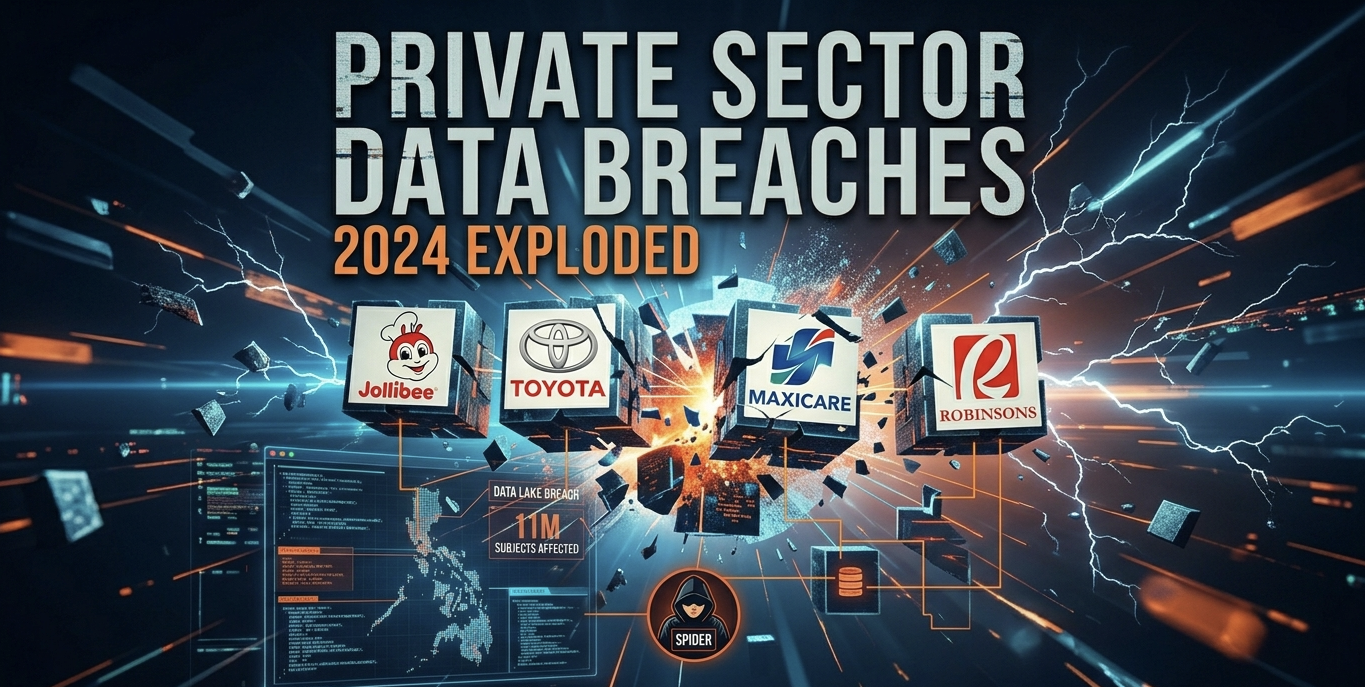
On June 22, 2024, an unknown party accessed Jollibee Foods Corporation's data lake, the centralized repository for all its business units. The exposed brands read like a food court directory: Jollibee, Mang Inasal, Red Ribbon, Chowking, Greenwich, Burger King Philippines, Yoshinoya, and Panda Express.
The NPC confirmed approximately 11 million data subjects were affected. Sensitive personal information including dates of birth and senior citizen identification numbers had been compromised. A cybercriminal operating under the handle “Spider” published the data on the dark web.
The NPC's investigation noted the breach may have been part of a coordinated global extortion campaign. Around 165 companies across different countries were recorded as targets in that same month. Jollibee may not have been specifically singled out. It may have simply been reachable.
That is not a reassuring thought.
The Others Were Not Far Behind
Toyota Makati's breach wasn't about volume. It was about duration. Customer records accumulated over multiple years surfaced on the dark web in 2024, discovered not by the company but by a cybersecurity advocacy group monitoring dark web activity. The question isn't just how the attacker got in. It's why nobody noticed for years.
Maxicare Healthcare Corporation confirmed 13,000 customer records were exposed. Small in volume. But healthcare data is different. A leaked medical history or HMO membership can affect employment, insurance coverage, and personal safety in ways an email address never could.
Robinsons Land Corporation also reported a data leak in the same period. Property developers hold contact information, income disclosures, identification records, and transaction histories. Real estate data is rarely thought of as sensitive. But for an attacker building a profile, it fills in the picture.
None of these companies made headlines for weeks. Some barely made the news cycle at all. That is part of the problem.
The Pattern Across All Four
Set them side by side and the symptom list looks identical.
Discovery came from outside, not inside. The theme across both sectors: reactive discovery, not proactive detection. Jollibee and Toyota Makati were both surfaced by Deep Web Konek before any internal disclosure. External watchers found the breach before the organizations themselves did.
The data was already gone before anyone knew it was taken. This is the actual problem. Not that attacks happen. Attacks will always happen. The problem is the detection gap: the time between when an attacker gets in and when the organization finds out. In mature security environments, that gap is measured in hours. In these cases, it was measured in months, and in some instances, potentially longer.
The response followed the same script: file, assure, delay. Optics over speed.
Affected individuals were among the last to find out. Under the Data Privacy Act of 2012, breach notification to data subjects is required within 72 hours of an organization becoming aware of the incident. This isn't just a communications failure. Under the Data Privacy Act, it is a legal one.
The real vulnerability isn't the attack. It's the detection gap and the delayed response that follows.
What This Series Is Building Toward
Two breaches in, the pattern is clear. The vulnerabilities are not unique to any one sector, size, or industry. They are organizational. They are structural. And they are fixable.
Part 3 looks at an organization that got it right before a breach forced the question: what a Security Operations Center actually does, and what “governance framework” means in plain language.
Because in 2024, the difference wasn't luck. It was who saw the open door first.
Need to See the Detection Gap Before the Breach?
I work with Philippine organizations that need stronger cybersecurity readiness, sharper incident awareness, and a clearer view of where operational exposure actually begins.
Request a Proposal or ConsultationReferences
- Philippine Daily Inquirer. (2024, June 25). NPC confirms data of 11M Jollibee customers leaked. https://business.inquirer.net/465190/npc-confirms-data-of-11m-jollibee-customers-leaked
- Philippine News Agency. (2024, June 27). Jollibee data breach could be related to global extortion activities. https://www.pna.gov.ph/articles/1227709
- Philstar. (2024, June 23). Jollibee Group probes data breach. https://www.philstar.com/headlines/2024/06/23/2364892
- Cybersecurity Asia. (2024, July). Chicha San Chen, Jollibee data breaches highlight increasing risks. https://cybersecurityasia.net/chicha-san-chen-jollibee-data-breach-risks/
- Asia Pacific Foundation of Canada. (2023, November). Data breaches plague Philippines as country scrambles to bolster defenses. https://www.asiapacific.ca/publication/data-breaches-plague-philippines-country-scrambles-bolster
- National Privacy Commission. (2024, June). NPC statement on Jollibee data breach. https://privacy.gov.ph